
Meet the Saints

St. Paul - The Persecutor Who Became Christianity's Greatest Missionary
Few people have experienced a transformation as dramatic as St. Paul. Long before he became one of Christianity's greatest champions, Paul was its fiercest enemy. He hunted followers of Jesus, approved of their imprisonment, and even witnessed the execution of Christianity's first martyr. Yet God had other plans. An encounter with the risen Christ changed everything. The man who once sought to destroy the Church would spend the rest of his life building it—traveling thousands of miles, enduring persecution, writing much of the New Testament, and proclaiming the Gospel to the ends of the Roman Empire. His story reminds us that no one is beyond God's mercy and that every life can be transformed by His grace.

Who Was Saul of Tarsus?
St. Paul was born around A.D. 5 in the prosperous city of Tarsus, located in modern-day Turkey. His Hebrew name was Saul. Unlike most of the Apostles, Paul came from an educated family. He was both a devout Jew and a Roman citizen, giving him unique privileges that would later help him travel freely throughout the Empire.
From an early age, Saul demonstrated exceptional intelligence. He studied under Gamaliel, one of Judaism's most respected teachers, and became a Pharisee—a member of a religious group devoted to strict observance of Jewish law. By every worldly measure, Saul appeared destined for influence and success. But he believed the growing movement of Jesus' followers threatened everything he held sacred.

A Brilliant Young Pharisee
Saul was passionate about defending his faith. Unfortunately, that passion was misdirected. As Christianity spread throughout Jerusalem, Saul became one of its most determined opponents.
The Book of Acts tells us he approved of the stoning of St. Stephen, the first Christian martyr. Soon afterward, Saul began entering homes, arresting Christians, and sending them to prison. He sincerely believed he was serving God. Instead, he found himself opposing God's greatest work.

The Road to Damascus
Everything changed on a dusty road leading to Damascus. Saul had received authority to arrest Christians living there. As he traveled, a brilliant light suddenly surrounded him. He fell to the ground. Then he heard a voice.
"Saul, Saul, why are you persecuting me?"
Startled, Saul replied, "Who are you, Lord?" The answer would change his life forever. "I am Jesus, whom you are persecuting." Blinded by the encounter, Saul was led into Damascus, where he spent three days in prayer and fasting. A disciple named Ananias, following God's instruction despite his fears, visited Saul and restored his sight. Saul was baptized. The persecutor had become a believer.
From Saul to Paul
After his conversion, Paul did not immediately become the famous missionary we know today. He spent years growing in faith, studying Scripture anew, and preparing for the mission God had entrusted to him.
Eventually, he began traveling throughout the Roman Empire, proclaiming that Jesus Christ had risen from the dead and that salvation was available to all people—not only the Jewish people, but also the Gentiles.
From this point forward, Scripture increasingly refers to him by his Roman name: Paul. His life would never be the same.
Missionary to the Gentiles
Paul traveled farther than perhaps any other Apostle. He journeyed by foot, by ship, and along Roman roads through Asia Minor, Greece, Cyprus, Malta, and eventually Rome itself. He founded Christian communities throughout the Mediterranean world. He preached in synagogues, marketplaces, homes, and public squares.
He faced opposition almost everywhere he went. He was beaten. Stoned. Imprisoned. Shipwrecked. Driven from cities. Yet he never stopped preaching Christ. Many of the letters Paul wrote to these early Christian communities eventually became books of the New Testament and continue to guide Christians nearly two thousand years later.
Arrest, Imprisonment, and Rome
Eventually, Paul's missionary work brought him into conflict with both religious authorities and Roman officials. After years of ministry, he was arrested in Jerusalem. Because he was a Roman citizen, Paul exercised his legal right to appeal directly to Caesar. That appeal brought him to Rome.
Even while under house arrest, Paul continued preaching the Gospel, welcoming visitors, encouraging believers, and writing letters that remain central to Christian teaching today.
Chains could not silence him.
Martyrdom in Rome

Around A.D. 64–67, during the persecution of Christians under Emperor Nero, Paul was sentenced to death. Because he was a Roman citizen, he was spared crucifixion. Instead, he was beheaded along the Ostian Way outside the city of Rome.
Christian tradition holds that his execution took place at the site now known as the Abbey of the Three Fountains. He was buried nearby. Centuries later, Emperor Constantine ordered a basilica built over Paul's tomb.
Today, pilgrims from around the world visit the Basilica of St. Paul Outside the Walls, one of Rome's four major papal basilicas.
Interesting Facts About St. Paul
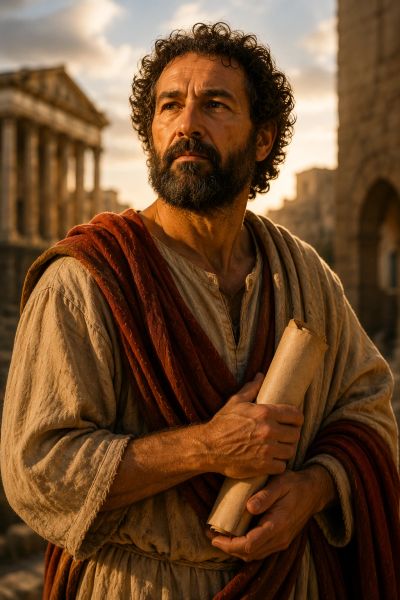
Paul Probably Didn't Change His Name
Many people believe Jesus changed Saul's name to Paul, but Scripture never says this. Saul was his Hebrew name, while Paul was his Roman name. He likely used whichever name best suited his audience.
He Traveled More Than 10,000 Miles
Paul's missionary journeys covered thousands of miles across the Roman Empire, mostly on foot or by sea.
He Was a Tentmaker
Paul supported himself financially by making tents, allowing him to preach without depending entirely on donations.
He Wrote Much of the New Testament
Thirteen New Testament letters are traditionally attributed to Paul, making him one of Christianity's most influential authors.
He Survived Extraordinary Hardships
Paul endured beatings, imprisonment, shipwrecks, hunger, sleepless nights, and countless dangers while spreading the Gospel.
Did You Know?
- Paul was born a Roman citizen—a rare privilege in the ancient world.
- His letters are proclaimed during Mass almost every week.
- Luke, the author of the Gospel of Luke and Acts, accompanied Paul on portions of his missionary journeys.
- Paul spent time imprisoned in Caesarea, Ephesus, and Rome.
- His tomb can still be visited beneath the Basilica of St. Paul Outside the Walls.
Lessons from St. Paul
Paul's story proves that no one is beyond redemption. He was not searching for Jesus. He was actively trying to eliminate Christianity. Yet Christ met him where he was. Paul's conversion reminds us that God can transform even the hardest heart.
Our past mistakes, failures, or sins do not determine our future. When we surrender our lives to Christ, He has the power to write an entirely new story. Like Paul, each of us is called not simply to believe the Gospel, but to share it boldly with the world.
Pilgrim's Connection
A visit to the Basilica of St. Paul Outside the Walls is one of the most meaningful experiences on a pilgrimage to Rome. Standing before the Apostle's tomb, pilgrims are reminded that the Gospel spread across continents because one man answered God's call with courage and perseverance.
Many pilgrims also visit the Abbey of the Three Fountains, the traditional site of Paul's martyrdom, where his earthly journey ended and his eternal reward began. Walking these sacred places brings Paul's remarkable story to life and reminds us that God continues to call ordinary people to extraordinary missions today.