
Meet the Saints

St. Peter - The Fisherman Who Became the First Pope
When people think of the great saints of Christianity, one name stands above almost all others: St. Peter. His name is spoken in every corner of the Catholic world. Pilgrims travel thousands of miles to visit his tomb beneath St. Peter's Basilica in Rome. His image appears in churches, paintings, statues, and stained glass windows across the globe. Yet Peter did not begin his life as a saint. He began as a fisherman. In fact, if you had met Peter before he met Jesus, you probably would have never imagined that he would one day become the leader of the Church and one of the most influential figures in human history. His story is a powerful reminder that God often chooses ordinary people to accomplish extraordinary things.

A Fisherman from Galilee
Peter was born in the small fishing village of Bethsaida near the Sea of Galilee. His original name was Simon. Like many men of his time, he worked with his hands. Fishing was hard, physically demanding work. Long days and sleepless nights were common. Peter was not a scholar, a priest, or a member of the religious elite.
He was simply a working man trying to provide for his family. Everything changed when he encountered Jesus of Nazareth. One day, Jesus approached Simon and his brother Andrew with a simple invitation: "Follow me, and I will make you fishers of men." They immediately left their nets and followed Him.

The Rock
Jesus saw something special in Simon. At one point during His ministry, Jesus gave Simon a new name:
"You are Peter, and upon this rock I will build my Church." (Matthew 16:18)
The name Peter comes from the Greek word Petros, meaning "rock." This was more than a nickname. It was a mission. Jesus entrusted Peter with a unique leadership role among the Apostles and gave him the "keys of the kingdom," symbolizing authority and responsibility within the Church. For this reason, Catholics regard St. Peter as the first Pope.

Peter's Greatest Failure
One of the reasons Peter is so relatable is that he was far from perfect. Although he loved Jesus deeply, Peter often acted impulsively. He spoke before thinking. He was courageous one moment and fearful the next.
The most painful example occurred during the Passion of Christ After Jesus was arrested, Peter followed from a distance. Three times people recognized him as one of Jesus' followers. Three times Peter denied knowing Him. Just as Jesus had predicted. When the rooster crowed, Peter realized what he had done. Scripture tells us that he went away and wept bitterly. It was one of the greatest failures of his life. Yet it was not the end of his story.
Peter's Greatest Triumph
After the Resurrection, Jesus sought Peter out. On the shore of the Sea of Galilee, Jesus asked him three times: "Do you love me? Each time Peter answered yes. Each time Jesus responded: "Feed my sheep."
With those words, Peter was restored and commissioned to lead the growing Christian community.
The man who had denied Christ became one of Christianity's boldest witnesses.
On Pentecost, Peter preached to thousands, helping launch the mission of the Church. He traveled, taught, performed miracles, and spread the Gospel throughout the Roman world. The fearful fisherman had become a fearless shepherd.
Martyrdom in Rome

According to ancient Christian tradition, Peter eventually traveled to Rome, the capital of the Roman Empire. There he continued preaching the Gospel despite growing persecution. Around A.D. 64–67, during the reign of Emperor Nero, Peter was arrested and sentenced to death. Tradition tells us that Peter requested to be crucified upside down because he did not consider himself worthy to die in the same manner as Jesus. His execution took place on Vatican Hill. Today, the magnificent St. Peter's Basilica stands above the place where he was buried nearly two thousand years ago.
Interesting Facts About St. Peter
Peter Was Married
Many people are surprised to learn that Peter was married. The Gospels mention Jesus healing Peter's mother-in-law, which clearly indicates he had a wife.
He Walked on Water
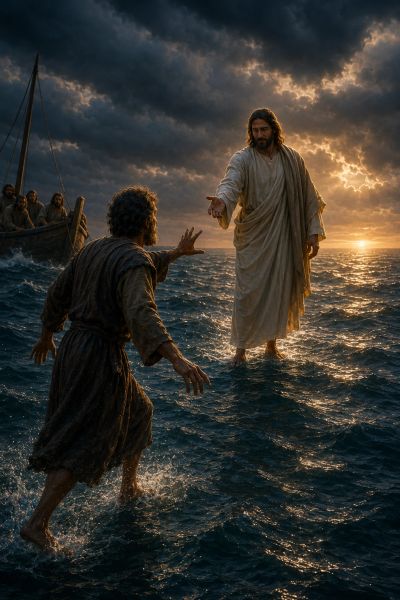
Peter is the only Apostle recorded as having walked on water. Although he began to sink when fear overtook him, he remains the only disciple who stepped out of the boat.
He Was Present at Major Events
Peter witnessed some of the most important moments in Christ's ministry, including the Transfiguration, the raising of Jairus' daughter, and Jesus' agony in the Garden of Gethsemane.
His Tomb Was Hidden for Centuries
Early Christians carefully preserved the location of Peter's burial site. Archaeological excavations beneath St. Peter's Basilica during the twentieth century uncovered evidence strongly supporting the ancient tradition regarding his tomb.
He Is One of the Most Frequently Mentioned People in the New Testament
Aside from Jesus Himself, Peter is mentioned more often than any other individual in the New Testament.
Did You Know?
- St. Peter's Basilica is not actually the Pope's cathedral. The Pope's cathedral is the Archbasilica of St. John Lateran in Rome.
- Peter's original name was Simon. Jesus later gave him the name Peter.
- The crossed keys often seen in Catholic art represent the keys of the Kingdom entrusted to Peter by Christ.
- Peter is traditionally regarded as the patron saint of fishermen.
- Pilgrims can visit the Vatican Necropolis beneath St. Peter's Basilica and stand remarkably close to the area where Peter was buried.
- The famous bronze statue of St. Peter inside St. Peter's Basilica has feet worn smooth by centuries of pilgrims touching and kissing them.
Lessons from St. Peter
Peter's life reminds us that holiness is not about perfection. He made mistakes. He doubted. He failed. He denied Jesus at the very moment he needed courage most. Yet God did not abandon him. Instead, God transformed him.
Peter's story teaches us that our failures do not define us. What matters is our willingness to return to Christ, trust His mercy, and continue forward. The fisherman who once denied Jesus became the rock upon which Christ built His Church. If God could accomplish that through Peter, imagine what He can accomplish through us.
Pilgrim's Connection
One of the most moving experiences on a pilgrimage to Rome is standing within St. Peter's Basilica and remembering that beneath its marble floors lies the tomb of the fisherman from Galilee.
For nearly two thousand years, Christians have journeyed to Rome to honor the witness of St. Peter and to deepen their faith where his earthly journey came to an end. His story continues to inspire pilgrims from around the world—and perhaps it will inspire your journey as well.