
Meet the Saints

St. Teresa of Ávila- The Woman Who Reformed the Church—One Soul at a Time
When most people imagine a saint, they picture someone who lived a life of unwavering holiness from beginning to end. St. Teresa of Ávila would quickly challenge that assumption. She struggled with distractions. She questioned herself. She endured years of spiritual dryness. She battled serious illness, criticism, and opposition from both inside and outside the Church. Yet through perseverance and an extraordinary friendship with Christ, Teresa became one of the greatest spiritual teachers in Christian history. Her life reminds us that sainthood is not reserved for the perfect. It belongs to those who continually open their hearts to God's transforming grace. Today, pilgrims travel from around the world to the ancient city of Ávila, Spain, to walk where she walked and discover the remarkable woman whose writings continue to inspire millions.

Who Was Teresa Sánchez de Cepeda y Ahumada?
Teresa was born in 1515 within the fortified medieval city of Ávila, Spain. She grew up in a devout Catholic family during one of Spain's most influential periods of history.
From an early age, Teresa possessed a vivid imagination, remarkable intelligence, and an adventurous spirit. She loved reading stories about saints and heroes. In fact, as a young girl, she and her brother once attempted to leave home in hopes of becoming martyrs, believing there could be no greater way to serve Christ.
Their journey ended only a short distance from home when family members found them and brought them back. It would not be Teresa's last attempt to pursue greatness.

A Spirited Young Girl
Despite her early love for the saints, Teresa was also very much a normal young woman. She enjoyed conversation. She appreciated beautiful clothing. She delighted in friendships and social gatherings.
As she entered adulthood, her desire for comfort and popularity sometimes overshadowed her spiritual life. Eventually she entered the Carmelite convent of the Incarnation in Ávila, but even there she found herself divided between her desire for God and the distractions of everyday life.
For nearly twenty years, Teresa described herself as living somewhere between wholehearted devotion and spiritual complacency. Many readers find comfort in this part of her story. She was not born extraordinary. She became extraordinary by continually returning to God.

The Long Road to Holiness
Teresa's greatest turning point did not happen overnight. After suffering a life-threatening illness and spending long periods confined to bed, she began to realize that God desired something much deeper from her.
One day, while praying before a statue of the suffering Christ, Teresa experienced a profound conversion of heart. She recognized that Christ had never stopped loving her—even during the years when she had allowed other things to distract her.
That realization changed everything. Prayer became less about reciting words and more about entering into a living friendship with Jesus. It became the foundation of her entire life.
Friendship with Christ
Teresa often described prayer in remarkably simple language. For her, prayer was:
"Nothing else than an intimate sharing between friends; it means taking time frequently to be alone with Him who we know loves us."
This understanding transformed not only her own spiritual life but also Christian spirituality for generations to come. Teresa experienced profound moments of contemplation and mystical prayer, yet she always reminded others that genuine holiness begins with humility, trust, and perseverance. Her famous work, The Interior Castle, describes the soul as a magnificent castle with many rooms, inviting every Christian to journey ever deeper into friendship with God.
Reforming the Carmelites
As Teresa's spiritual life matured, she became convinced that the Carmelite Order needed renewal. She believed religious communities should embrace greater simplicity, prayer, poverty, and dependence upon God.
Her reforms were not welcomed by everyone. She faced criticism. Opposition. Misunderstanding. Even hostility. Yet Teresa remained remarkably joyful.
Traveling throughout Spain—often by mule over rough roads—she founded seventeen reformed Carmelite convents.
What began as one woman's desire for deeper prayer eventually transformed an entire religious order and left a lasting impact on the Catholic Church.
Her Final Journey
Teresa spent the final years of her life continuing to travel, teach, write, and establish new communities.
In 1582, while visiting the town of Alba de Tormes, she became seriously ill. There she peacefully surrendered her life to God.
She was later canonized in 1622. In 1970, Pope St. Paul VI declared Teresa a Doctor of the Church, recognizing her writings as among the greatest treasures of Christian spirituality. She was the first woman in history to receive that honor.
Interesting Facts About St. Teresa
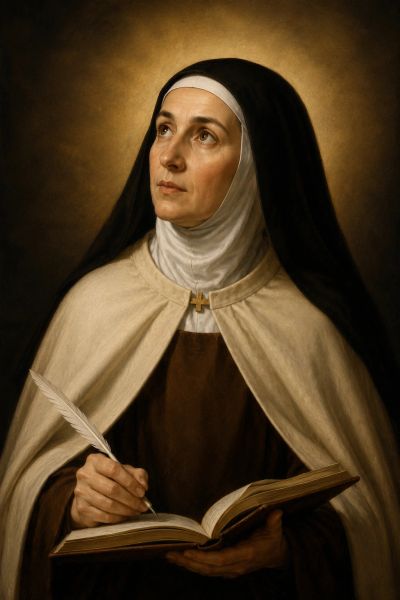
She Was the First Female Doctor of the Church
In 1970, St. Teresa became the first woman ever proclaimed a Doctor of the Church because of the enduring value of her spiritual writings.
She Founded Seventeen Convents
Despite poor health and constant opposition, Teresa traveled extensively throughout Spain to establish seventeen reformed Carmelite communities.
She Was an Accomplished Author
Her books, including The Interior Castle and The Way of Perfection, remain classics of Christian spirituality and continue to be read around the world.
She Possessed a Remarkable Sense of Humor
Teresa believed holiness and joy belonged together. She often encouraged her sisters to laugh and enjoy life while remaining deeply committed to prayer.
Her Body Rests in Alba de Tormes
Pilgrims can venerate her tomb at the Basilica of the Annunciation in Alba de Tormes, one of Spain's most important pilgrimage destinations.
Did You Know?
- Teresa once remarked, "If this is how God treats His friends, no wonder He has so few."
- She traveled thousands of miles across Spain on horseback and by mule.
- She wrote many of her greatest works while suffering from chronic illness.
- She is one of the patron saints of Spain.
- Her feast day is celebrated each year on October 15.
- Her writings have influenced countless saints, popes, priests, religious, and lay Catholics for more than four centuries.
Lessons from St. Teresa
St. Teresa reminds us that holiness begins with prayer. Not complicated prayers. Not perfect prayers. Simply spending time with Christ. She teaches that every soul is invited into a deeper relationship with God, regardless of past failures, weaknesses, or distractions.
Her life also reminds us that courage often looks quiet. It is found in faithful prayer. Patient perseverance. Daily obedience. And trusting God one step at a time. Like Teresa, we are all invited to discover that the greatest adventures often take place not on distant roads, but within our own hearts.
Pilgrim's Connection
Walking through the ancient streets of Ávila is like stepping into the pages of Teresa's life. Pilgrims can visit her birthplace, the Convent of St. Teresa, the Monastery of the Incarnation where she lived for many years, and the magnificent medieval walls that have stood since her lifetime.
Many pilgrims continue onward to Alba de Tormes, where St. Teresa's tomb has become a place of prayer and inspiration for generations. Standing in these sacred places, visitors quickly discover why Teresa continues to invite every pilgrim—not merely to travel across Spain—but to journey ever more deeply into friendship with Christ.