
Meet the Saints

St. John the Apostle - The Beloved Disciple Who Never Stopped Following Christ
Among the Twelve Apostles, few were privileged to witness as much of Jesus' earthly ministry as St. John. He stood beside Christ during His greatest miracles, leaned against His shoulder at the Last Supper, remained faithfully beneath the Cross when nearly everyone else fled, and lived long enough to record some of the most profound words ever written about the life of Jesus. John's story is not one of dramatic speeches or bold leadership. Instead, it is a story of steadfast faithfulness. While others struggled with fear, doubt, or ambition, John learned that true greatness is found simply by remaining close to Christ. His life reminds every pilgrim that the journey of discipleship is not measured by extraordinary accomplishments but by enduring love and unwavering devotion.

Who Was St. John?
John was the son of Zebedee and Salome and the younger brother of St. James the Greater. The family operated a successful fishing business along the shores of the Sea of Galilee, working alongside Simon Peter and Andrew.
Before meeting Jesus, John likely spent time listening to the preaching of St. John the Baptist. His heart was already searching for the Messiah, making him one of the first to recognize Christ when He appeared.
When Jesus called John and James to leave their fishing nets and follow Him, they responded immediately. That single decision would forever change the course of history.

A Son of Thunder
Jesus affectionately nicknamed James and John Boanerges, meaning
"Sons of Thunder."
The title reflected their fiery personalities. At one point, they wanted to call down fire from heaven upon a Samaritan village that rejected Christ. On another occasion, they boldly asked to sit at Jesus' right and left hand in His Kingdom.
These moments reveal two young men who possessed tremendous zeal but still had much to learn. Rather than condemning them, Jesus patiently transformed that passion into humble love.

The Disciple Closest to Jesus
As John's faith matured, he became part of Jesus' closest inner circle alongside Peter and James. He witnessed events few others experienced:
- The raising of Jairus' daughter
- The Transfiguration
- Jesus' agony in the Garden of Gethsemane
At the Last Supper, John occupied the place of honor beside Jesus, traditionally understood to be the disciple reclining closest to the Lord. His Gospel never identifies him by name. Instead, he simply refers to himself as
"the disciple whom Jesus loved."
This wasn't an expression of pride. Rather, it reflected John's understanding that his identity was found entirely in Christ's love.
Faithful at the Foot of the Cross
When Jesus was arrested, nearly all the disciples fled. John did not.
Standing beside the Blessed Virgin Mary beneath the Cross, he remained with Jesus during His final hours. From the Cross, Christ entrusted His mother to John's care:
"Woman, behold, your son... Behold, your mother."
From that moment forward, John welcomed Mary into his home and cared for her as his own mother.
For Catholics, this moment carries profound significance. It symbolizes not only John's personal responsibility but also Mary's spiritual motherhood over all believers.
Apostle, Evangelist, and Exile
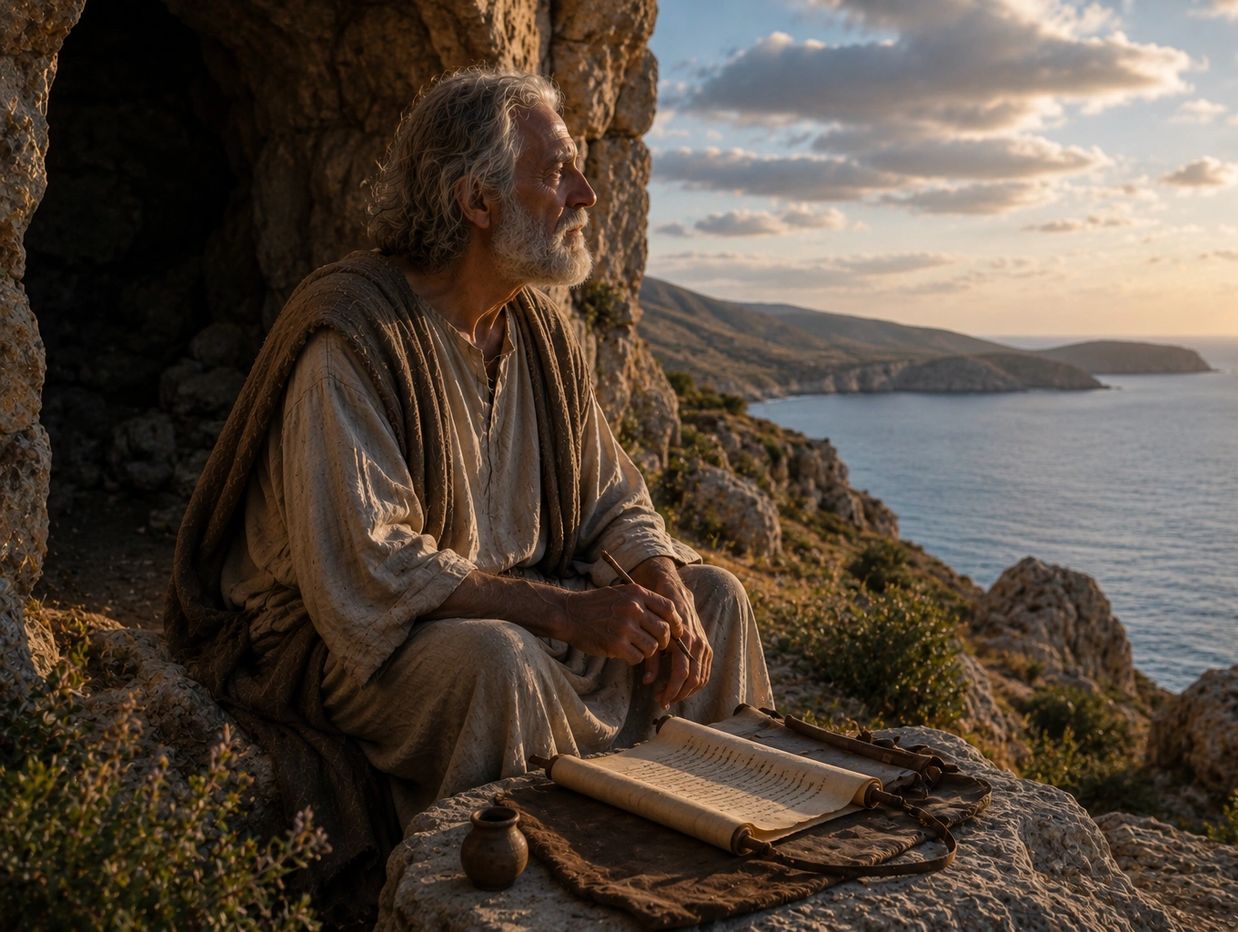
Following Pentecost, John devoted his life to preaching the Gospel throughout the Roman world. He eventually settled in Ephesus, where he helped lead the growing Christian community and continued caring for the Blessed Virgin Mary. During the persecution under Emperor Domitian, John was exiled to the island of Patmos. It was there, amid solitude and suffering, that he received the extraordinary visions recorded in the Book of Revelation. Unlike the other Apostles, John is traditionally believed to have died of old age, making him the only member of the Twelve not to suffer martyrdom by execution. Yet his long life became its own form of faithful witness.
Interesting Facts About St. John

He Was Probably the Youngest Apostle
Many scholars believe John may have been a teenager when Jesus called him to follow along the Sea of Galilee.
He Wrote Five Books of the New Testament
John is traditionally credited with writing the Gospel of John, three Epistles, and the Book of Revelation.
He Is Symbolized by an Eagle
The eagle represents the soaring theology of John's Gospel, which begins not with Bethlehem, but with Christ's eternal existence: "In the beginning was the Word."
He Cared for the Blessed Virgin Mary
After the Crucifixion, John welcomed Mary into his home, faithfully carrying out Christ's final request.
He Was the Only Apostle to Die Naturally
Christian tradition holds that John lived into old age, making him the only one of the Twelve Apostles who was not martyred.
Did You Know?
- St. John stood at the foot of the Cross while most of the other Apostles fled.
- He is traditionally known as "The Beloved Disciple."
- John received the visions recorded in the Book of Revelation while exiled on the island of Patmos.
- The Basilica of St. John in Ephesus is traditionally believed to mark the location of his tomb.
- His Gospel contains one of Christianity's most famous declarations: "God is love."
Lessons from St. John
John teaches us that holiness is not always loud. He began as an impulsive young fisherman eager for power and recognition. Through years spent walking beside Christ, his ambition gradually gave way to humility, compassion, and unwavering love. He remained when others ran. He believed when others doubted. He loved when others feared.
Every Christian eventually faces moments when following Christ becomes difficult. The example of St. John reminds us that faithfulness often means simply remaining close to Jesus, especially during seasons of suffering, uncertainty, or silence. Like John, we are called not merely to admire Christ from a distance but to walk beside Him every day.
Pilgrim's Connection
Pilgrims following in the footsteps of St. John can encounter several remarkable places connected with his life and ministry. Near the ancient city of Ephesus stands the traditional site of the House of the Virgin Mary, where John is believed to have cared for Mary following Christ's crucifixion. Nearby, the impressive ruins of the Basilica of St. John mark the traditional location of the Apostle's tomb. For centuries, Christians have traveled there to honor the beloved disciple who faithfully proclaimed the Gospel until the end of his life.
Farther west, on the Greek island of Patmos, pilgrims can visit the Cave of the Apocalypse, where John received the visions recorded in the Book of Revelation, as well as the magnificent Monastery of St. John the Theologian, which has welcomed pilgrims for nearly a thousand years. Each of these sacred places invites visitors to reflect on John's enduring message: remain close to Christ, trust Him completely, and allow His love to shape every aspect of your life.